
BS. Biomedical Science
PROGRAM MISSION
The Biomedical Sciences program at Diné College provides students with the knowledge and practical skills needed to pursue careers in research, healthcare, and biotechnology while preparing them to address critical health challenges. The program is designed to support student success by fostering career development, encouraging graduate study, enhancing employment and advancement opportunities, and preparing graduates to serve and contribute to the Navajo Nation.
PROGRAM GOALS
Goal 1: To obtain the necessary knowledge and skills essential for a career in medical sciences or allied healthcare professions. Biomedical Sciences majors need more than the average amount of Science, Operations Analysis, and Programming.
Objective 1: Students will successfully complete the comprehensive courses in clinical Chemistry/ biochemistry, molecular biology/genetics, clinical microbiology, infectious disease, and immunology. Students will get training in various analytical methodologies using spectrophotometry, PCR/RT-PCR, Immunoblotting, ELISA, CRISPER, Electrophoresis, etc.
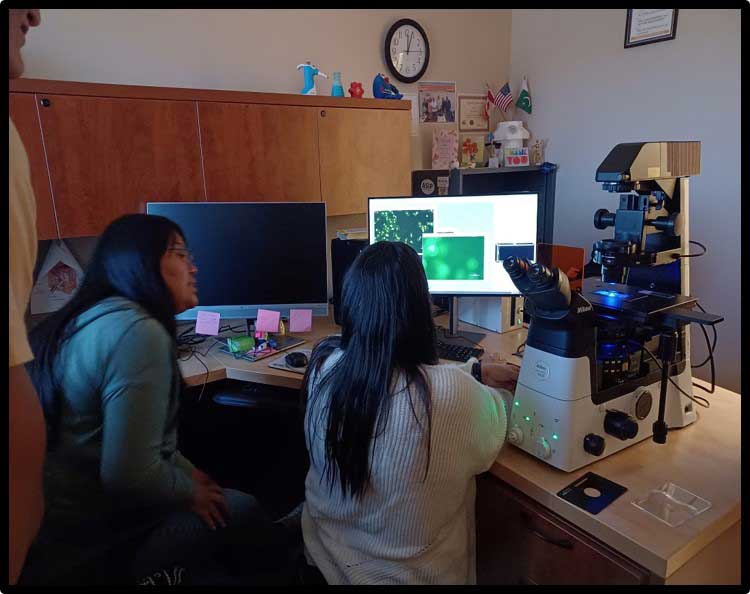
Objective 2: Students will participate in translational research and hands-on experiences through laboratory exercises and group projects.
Goal 2: To grace the interpersonal communication skills to convey the results of scholarly work and to be able to work with others in groups and teams. Reading Comprehension, Science, and Critical Thinking are the three most important skills for people in the field.
Objective 1: Students will participate in Journal clubs and research projects to be trained in complex problem solving, Active learning, and Judgement & Decision making.
Objective 2: Students will be encouraged to attend scientific workshops/ training and meetings to learn social perceptiveness and management of personal resources.
Goal 3: To develop competent Biomedical Native Scientists, it is necessary to develop operational skills.
Objective 1: Students will be trained in collecting, organizing, evaluating, and analyzing data, troubleshooting, instrument calibration, and time management.
Objective 2: Students will be encouraged to participate in summer internship/research opportunities, proposal writing, grant writing, poster and paper presentations, and publication to learn coordination and system evaluation skills.
PROGRAM STUDENT LEARNING OUTCOMES
PSLO1. (Nitsahakees: thinking) Using critical thinking skills, students will be able to outline the different responses of the human body to physical, chemical, and microbial interaction, and demonstrate a commitment to the application of biomedical science in the improvement of health disparities. Additionally, via a series of laboratory experiments, they will be trained in collecting, organizing, evaluating and analyzing data, troubleshooting, instrument calibration, equipment selection, operation monitoring, and time management.
PSLO2: (Nahat’a: planning) Through research and synthesizing information, students will be able to describe a chosen health care profession in detail, obtain knowledge from other students’ descriptions, and use this knowledge to reflect on their own career path. This training will develop their social perceptiveness and decision-making skills.
PSLO3. (Iiná: performance) By implementing course material, students will be able to identify structures of the human body, describe their functional interrelatedness, and communicate scientific information successfully, with specialized knowledge of concerns in health-related fields. They will learn various analytical methodologies and laboratory techniques to master the skills as required for successful completion of the program.
PSLO4. (Siihásin: application and evaluation) By reflecting on and applying the significance of their educational goals, students will demonstrate a professional scholastic behavior and attitude that will make them active listeners, problem solvers, team players and achievers.
2025 – 2026 Checklist
Bachelor of Science Degree
Biomedical Science (122–125 credits)
| General Education Requirements (63–64 hrs) | Upper Division Requirements (59–62 hrs) |
|---|---|
| Freshman Semester I BIO 181 General Biology I (4.0) CHM 151 General Chemistry I (5.0) ENG 101 College Composition I (3.0) MTH 110 College Algebra (4.0) Total: 16 hrs Freshman Semester II Total: 15 hrs Sophomore Semester III Total: 15–16 hrs Sophomore Semester IV Total: 16 hrs Prog Req: 63–64 hrs | Junior Semester I BIO 344 Cellular and Molecular Biology (4.0) CHM 310 Introduction to Pharmacology (4.0) CHM 360 Fundamental Biochemistry (3.0) PHY 110 Algebra-based Physics I (4.0) Total: 15 hrs Junior Semester II Total: 15 hrs Senior Semester III Total: 16 hrs Senior Semester IV Total: 13–16 hrs Prog Req: 59–62 hrs |
Suggested Elective Courses (including prerequisites)
PSY 315 (Health Psychology); PUH 395 (Epidemiology)
NAV 231 (Medical Terminology of Navajo); ENG 222 (Writing for the Sciences)
NAS 413 (Indigenous Research Methodologies); BIO 497 (Independent Study)
NIS 371 (Navajo Philosophy); BIO 390 (Principles of Forensic Sciences)
* MTH 251 Calculus for Life Sciences and Business
Must pass all courses with “C” grades or higher
DEAN'S OFFICE
Acting Dean, School of STEM
Tuba City Campus
Phone: (928) 283-5113 ext. 07520
Research Labs: 7538, 7539
Email: stabassum@dinecollege.edu
Administrative Assistant
Tsaile Campus
Phone: 928-724-6731
Email: syazzie@dinecollege.edu