Diné College’s New Vice President Unveils Plan to Strengthen Institution’s Future
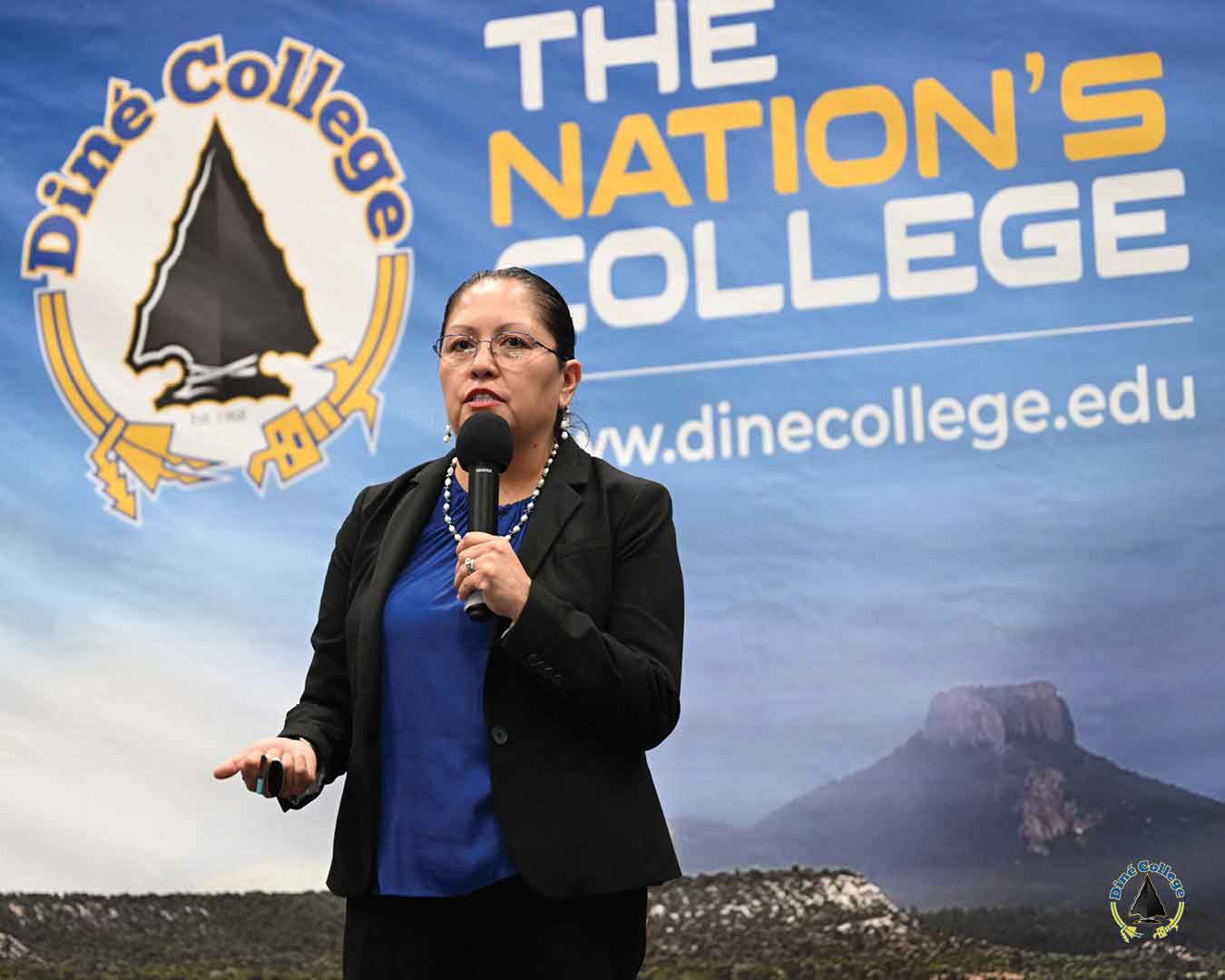
TSAILE, Ariz. Serena Denetsosie, vice president of the Office of Institutional Advancement at Diné College, spoke at the 2026 Fall Convocation on Monday, Aug. 10, 2026, where she shared a bold plan for three departments — the Diné Policy Institute, the Development Office, and Marketing and Communications — to strengthen the college’s future and better serve Navajo students and communities.
Denetsosie explained that these three departments each have a distinct role but grow stronger when they work together. The Diné Policy Institute creates knowledge and solutions. The Development Office builds relationships and resources. Marketing and Communications tells the college’s story and expands its reach. “Each has a distinct role, but they’re strongest when they work together,” Denetsosie said.
She joined Diné College in April 2026. She earned both her bachelor’s and master’s degrees at Arizona State University. Her career began in prevention work and Native American mental health education, along with research and evaluation. She later moved into nonprofit work, where she discovered her passion for research.
Denetsosie then served in the Office of Indian Education at the Arizona Department of Education throughout the pandemic. Afterward, she started her own consulting business. She helped philanthropic organizations bring more funding and resources to tribal nations, working with all 22 tribes in Arizona. “Each of those experiences taught me about community, Indigenous data sovereignty, partnerships, and accountability,” Denetsosie said.
She described the Diné Policy Institute as a place where research connects directly to the needs of the people. The Navajo Nation faces complex challenges in economic development, housing, water, education, health care, and technology. She said the institute can bring together faculty, students, community leaders, and policymakers to study these issues.
Denetsosie also called for research led by Navajo people. For too long, she said research about tribal nations was done elsewhere, by outsiders. She wants students and community members to shape the questions and keep the knowledge with the people it serves. “That is self-determination in education,” Denetsosie said.
She said the Development Office starts with relationships, not fundraising. The office works with alumni, foundations, businesses, government agencies, and community partners who believe in the college’s mission. Strong partnerships, she said, rest on trust, respect, and mutual benefit.
Marketing and Communications, she added, makes the college’s daily work visible. Its job is to tell the college’s story truthfully and consistently. Denetsosie said the story should reflect the voices of students, families, partners, and communities.
Throughout her remarks, Denetsosie grounded her plan in Diné philosophy and the principle of hózhó, which reflects balance, harmony, and reciprocal relationships. She said progress means moving forward while honoring traditional knowledge and caring for future generations.
She also spoke about lifelong learning. In Western systems, she said, a degree can seem like the highest goal. But traditional teachings view learning as something that continues throughout life. “Traditionally, we never end our learning all the way to old age,” Denetsosie said.
Denetsosie stressed that students must remain at the center of the college’s work. She reminded the audience that educators learn from students, too. She also pointed to real barriers students face, such as limited access to technology and reliable internet. “We have to remember that we have to spend some of that extra time to help students connect to those resources,” Denetsosie said.
Accountability, she said, ties all of this work together. Good intentions are not enough. The college must measure its impact and ask whether its efforts truly help people and communities. “Activity alone is not a success,” Denetsosie said. “We have to measure impact.”
She closed by recalling the college’s founding vision. Navajo elders created Diné College to serve Navajo people, and it helped transform tribal higher education across the United States. Denetsosie said the college’s next chapter will be shaped by its research, relationships, resources, stories, and, above all, its students.
“If we keep these principles, our students and communities at the center of our work, Diné College will continue to honor its history,” Denetsosie said.
About Diné College
Diné College was the first tribally controlled college established in the United States. Rooted in Diné culture, language, and philosophy, the college serves Navajo students and communities while preparing them for careers, further education, and service across the Navajo Nation and beyond.