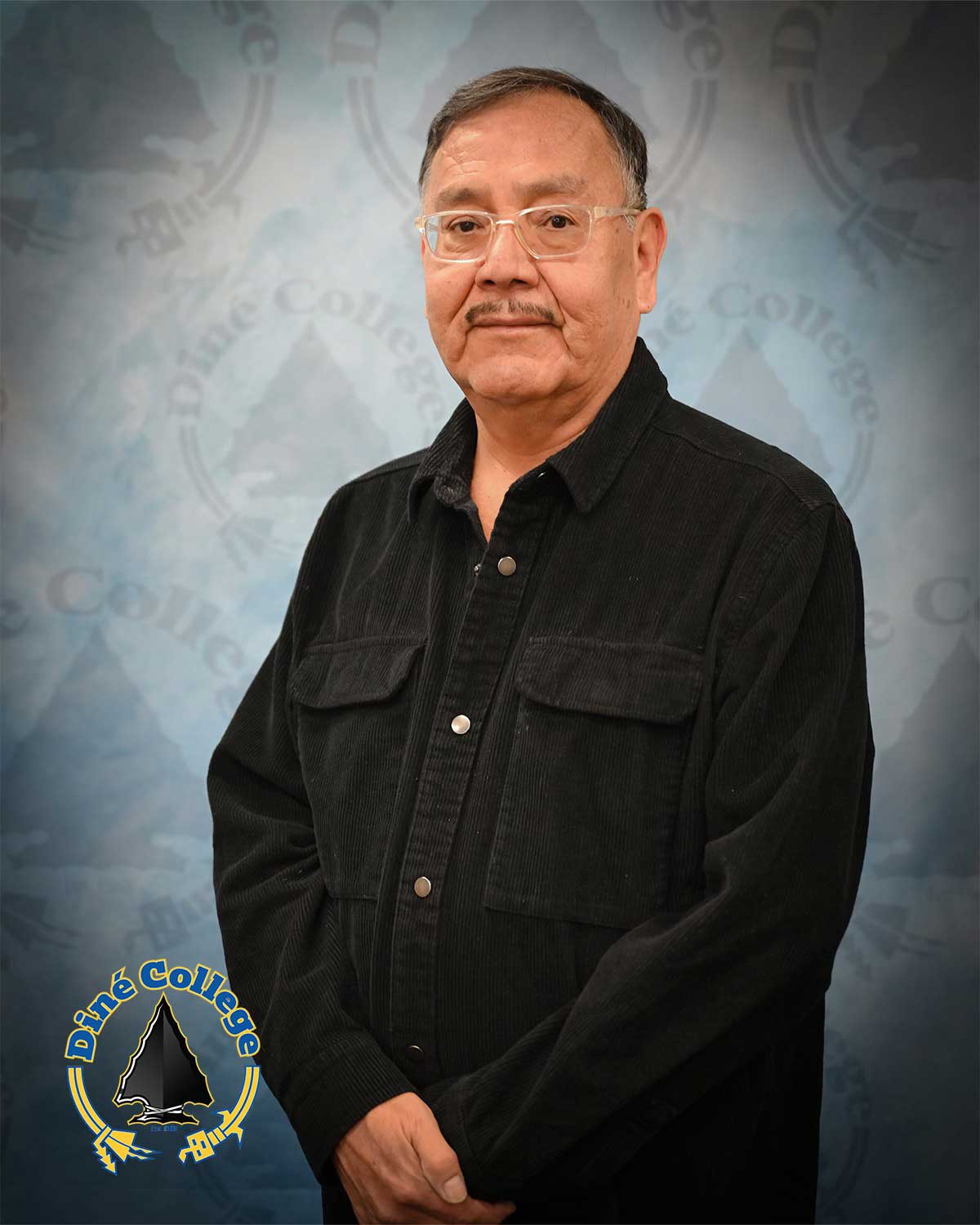
Irvin Morris: Weaving Stories and Leadership as Diné College’s New Dean of the School of Arts and Humanities
Irvin Morris is a Navajo (Diné) author, educator, and storyteller known for his powerful writing that blends traditional Diné stories with contemporary Native American life. He is best known for his acclaimed book From the Glittering World: A Navajo Story, a hybrid work that combines autobiography, history, sacred narrative (what non-Diné often refer to as “myth”), and fiction. His writing is deeply rooted in Diné oral traditions, yet it speaks with a modern voice, exploring themes such as identity, displacement, survival, cultural memory, and the ongoing effects of colonialism.
Morris is an enrolled member of the Navajo Nation and comes from the Tóbaahí (Water’s Edge) Clan, born for the Tótsohnii (Big Water) Clan; his maternal grandfather is Tó’áhaní, and his paternal grandfather is Kinyaa’áanii. He was raised in Naschitti, NM, in northwestern New Mexico, a landscape that often shapes and inspires his writing. Like many Indigenous authors of his generation, Morris straddles two worlds: the traditional and the modern, the spiritual and the historical, the personal and the political.
He achieved ABD status in Native American Studies at the State University of New York, earned a Master of Fine Arts (MFA) in Creative Writing from Cornell University, received a Bachelor of Arts in Literature and Creative Writing/Fiction from the University of California, and holds an Associate of Fine Arts in Creative Writing from the Institute of American Indian Arts.
He has taught literature and creative writing at several institutions, including Cornell, the State University of New York, the University of Arizona, Navajo Technical University, and Dine College. His work as a teacher is as important to his legacy as his work as a writer. He has mentored generations of Native students, helping them discover the power of their own voices and stories.
From the Glittering World, published in 1997, remains his best-known work. The title refers to the Fifth World in Diné cosmology—the world we live in now. The book is not a conventional novel, but a groundbreaking multi-genre work. It weaves together traditional Navajo stories, personal anecdotes, fictionalized accounts of historical events, and poetic reflections. It resists easy categorization, mirroring the complexity of Native experience itself.
Morris’s writing challenges the myths and stereotypes often found in mainstream portrayals of Native Americans. Instead, he offers nuanced, often gritty depictions of Native life—stories of struggle, trauma, humor, healing, and resilience. His use of multiple voices, fragmented narrative, and rich symbolism reflects both the Diné storytelling tradition and the literary innovations of contemporary Native literature.
Although Morris has not published a large body of work, his influence is profound. He is part of a generation of Native writers—alongside authors like Leslie Marmon Silko, Simon Ortiz, and N. Scott Momaday—who helped to reshape American literature by centering Indigenous perspectives.
As of today, Irvin Morris continues to write, teach, and serve his community. His contributions to literature and Native education are lasting, offering a powerful vision of what it means to live, remember, and imagine as a Diné person in a world shaped by colonization, but also by beauty, story, and survival.