Diné College Graduate Student Sheldon Chee Presents Innovative
Electrode Research at 2026 ERN Conference
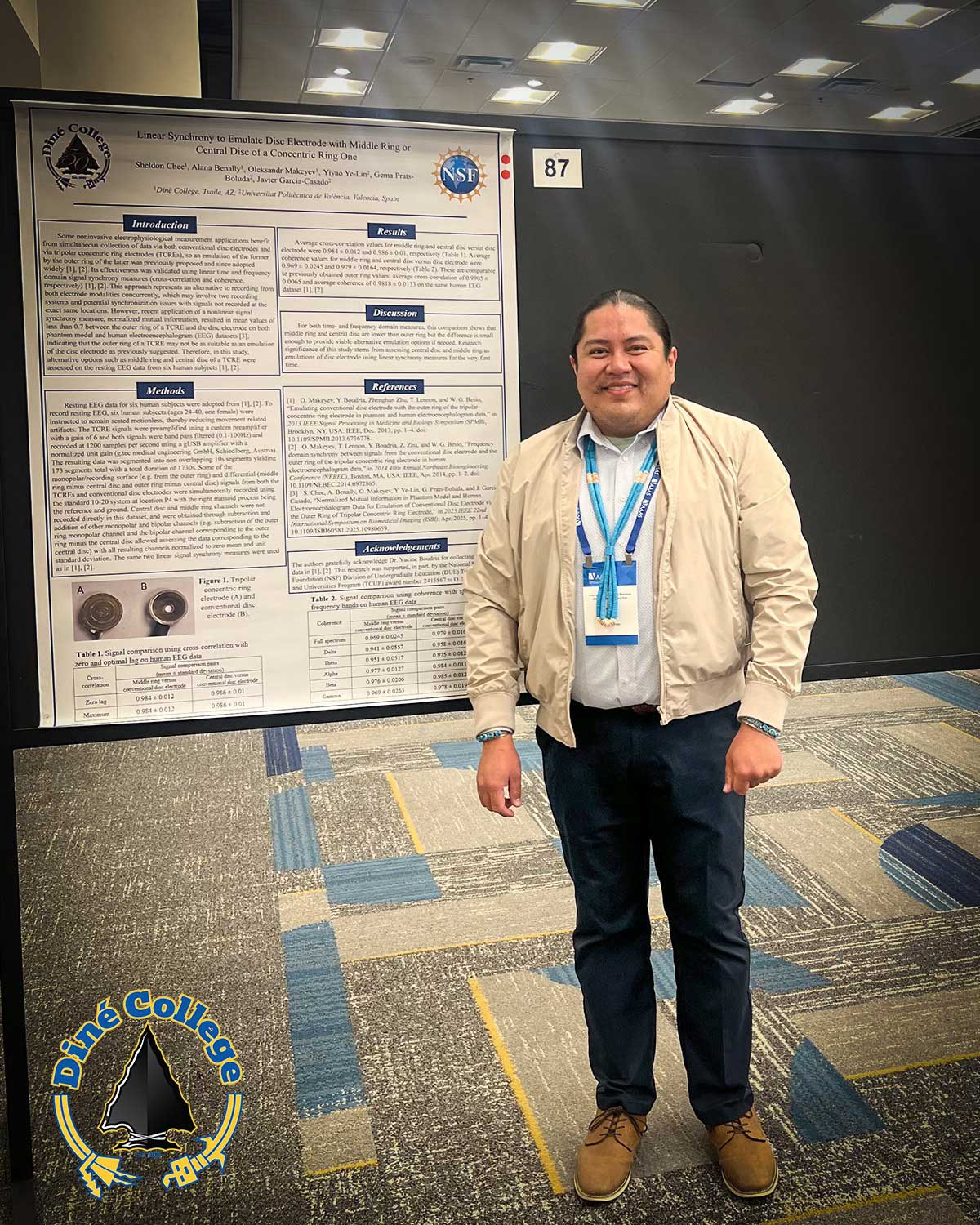
TSAILE, Ariz., March 31, 2026. Diné College graduate student Sheldon Chee presented his original biomedical research at the 2026 Emerging Researchers National Conference in STEM, held in Atlanta, GA, from March 19th to the 21st. The National Science Foundation supported Chee in his research as he showcased new methods for utilizing novel sensors to mimic the function of more traditional medical electrodes, aiming to improve existing medical technologies.
Chee delivered his abstract, titled “Linear Synchrony to Emulate Disc Electrode with Middle Ring or Central Disc of a Concentric Ring One,” to scientists and scholars at the event. In his research, a traditional disc electrode uses a single circular metal surface to contact the skin or scalp and record electrical activity. A concentric ring electrode features a central disc surrounded by one or more ring-shaped recording surfaces. His research explores a well-established method for using individual recording surfaces of one type of noninvasive electrophysiological electrode to emulate another, creating a direct connection between the method and its application since many disorders could benefit from simultaneous recording by both electrode modalities at the same time.
“Sheldon’s work not only demonstrated the existing emulation approach to be less effective than was previously believed but also proposed and assessed two alternative approaches for
the very first time,” Dr. Oleksandr Makeyev, Chee’s thesis advisor, said.
Chee earned his Bachelor of Science in Biomedical Sciences in December 2025 and scheduled his Master of Science in Biology thesis defense for April 2026. The Atlanta presentation covered
a substantial portion of his master’s thesis. This work, along with another research direction, accounts for Chee’s three first author peer-reviewed conference proceedings papers. Chee
already published the first one back in 2025 and expects to publish the remaining two later this year.
The Emerging Researchers National Conference requires all presented research projects to be externally funded; for Chee’s research, the National Science Foundation’s Tribal Colleges and
Universities program provided such support. Additionally, Chee won a competitive travel award from the conference organization, enabling him to present his findings in Atlanta.
This milestone marked the laboratory’s third ERN presentation: Frederick Lee represented Dr. Makeyev’s Mathematics for Engineering Applications lab back in 2018, while Alana Benally
presented her research in 2024.