Diné College Student Ian Nez Defends Trailblazing Research on Helicobacter pylori in Navajo Nation Water Sources
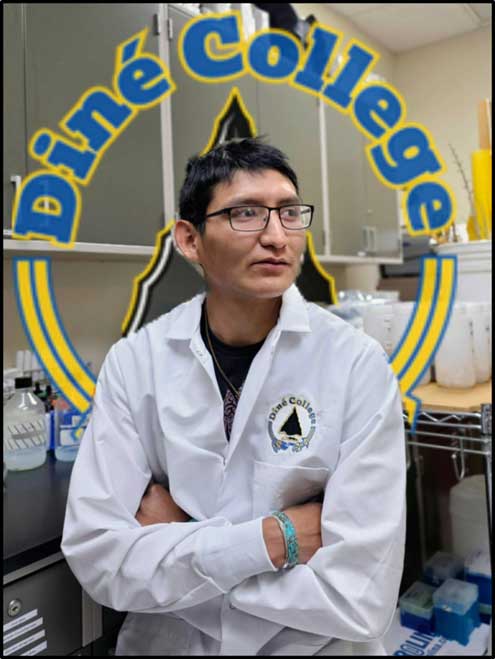
TUBA CITY, Navajo Nation, Arizona — May 11, 2026 — Ian Tabaahi Nez, a Master of Science in Biology candidate at the Diné College School of STEM, has successfully defended his thesis research, marking a significant development in environmental health research for the Navajo Nation. Nez is the 7th MS graduate student from Diné College and the 5th to graduate from Hakim’s Lab, completing his research under the guidance of Professor Dr. Shazia Tabassum Hakim, Interim Dean of STEM and biomedical sciences professor.
His thesis, titled “Evaluating the existence of Helicobacter pylori‘s unique virulence markers (cagA and vacA genes) in water samples collected from the Navajo Nation,” was successfully defended in Tuba City on May 5, 2026. The research was reviewed by a distinguished committee, including Professor Dr. Miranda Haskie, Dr. Nadeem, and Professor Dr. Fernando Monroy.
Nez’s study addresses a critical public health concern. While roughly 56–68% of Navajo adults in certain areas test positive for H. pylori—a bacterium linked to high rates of gastric cancer, which is three to four times higher in the Navajo Nation than in non-Hispanic white populations in the region—the precise environmental sources of infection remain under-researched.
“There are multiple studies on chemical contaminants in unregulated water resources within the Navajo Nation, and few studies on microbial contamination,” said Nez. “However, there is barely anything focused on the prevalence of H. pylori in these unregulated water resources.”
U.S. Environmental Protection Agency (EPA) includes Helicobacter pylori on its Contaminant Candidate List (CCL) but still, routine screening is based on traditional fecal indicator bacteria, such as E. coli, which may not effectively detect the presence of non-conventional H. pylori in water.
Additionally, this bacterium is very sensitive to environmental conditions and needs special conditions to grow in the lab. Furthermore, due to different environmental conditions this bacterium has ability to convert to Viable but Nonculturable (VBNC) state, in which this bacterium develops morphological changes, still alive but cannot be cultivated.
By investigating the presence of H. pylori DNA and cagA and vacA virulence markers in regional water, Nez’s work seeks to fill a crucial knowledge gap, determining if unregulated water acts as a significant vector for infection.
Following his successful defense, Nez will graduate this spring of 2026 with Summa Cum Laude honors. He plans to pursue a career as a Medical Laboratory Scientist, continuing his dedication to research and service for communities across the Navajo Nation.
For more information regarding this research or the MS Biology program at School of STEM, Diné College, Navajo Nation, Arizona, please contact Dr. Shazia Tabassum Hakim at stabassum@dinecollege.edu
About Diné College School of STEM:
Located on the Navajo Nation, the Diné College School of STEM is dedicated to providing high-quality science, technology, engineering, and mathematics education, integrating Diné traditional knowledge with modern science to address regional challenges.