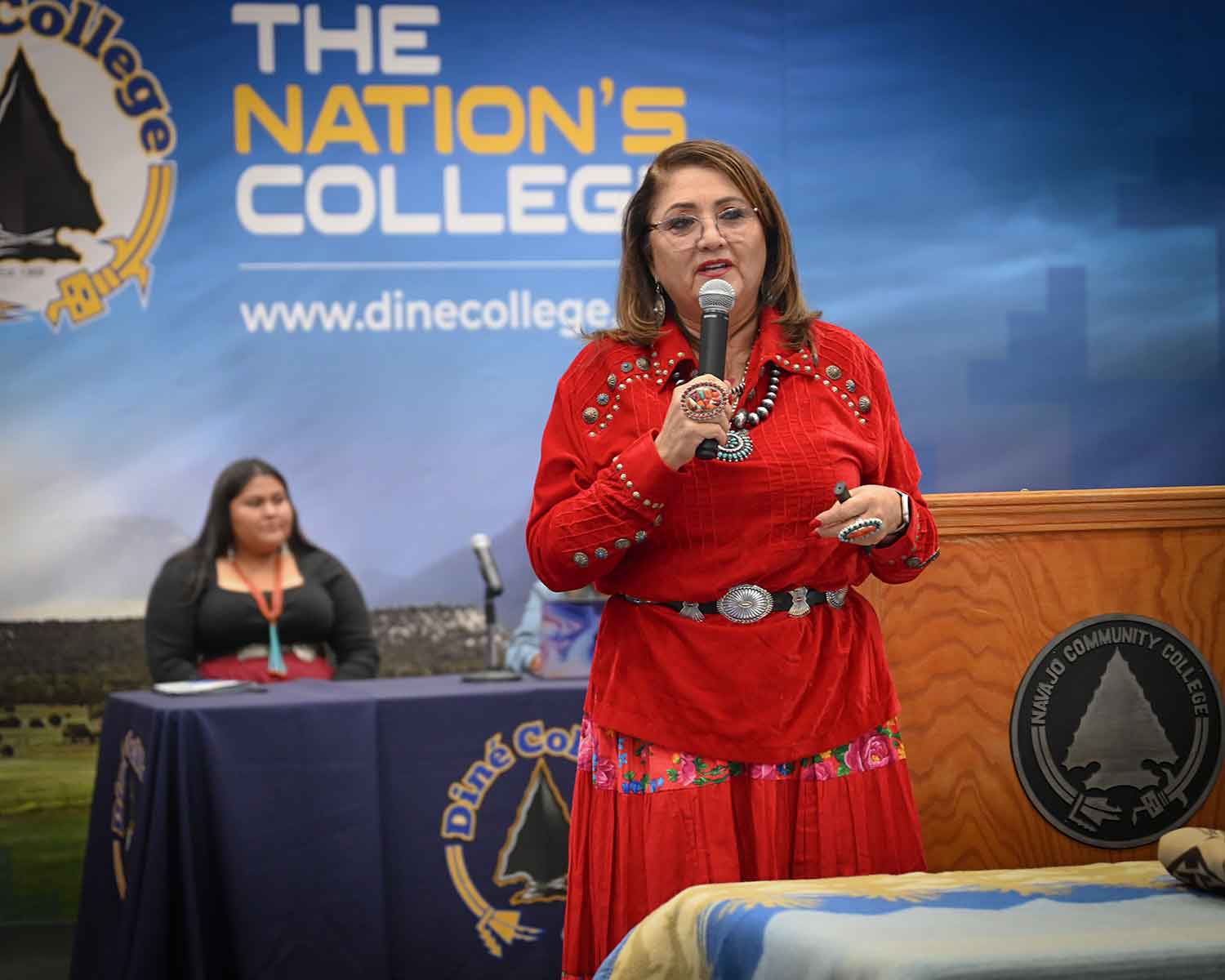
Diné College President Outlines Student-Centered Vision in First State of the College Address
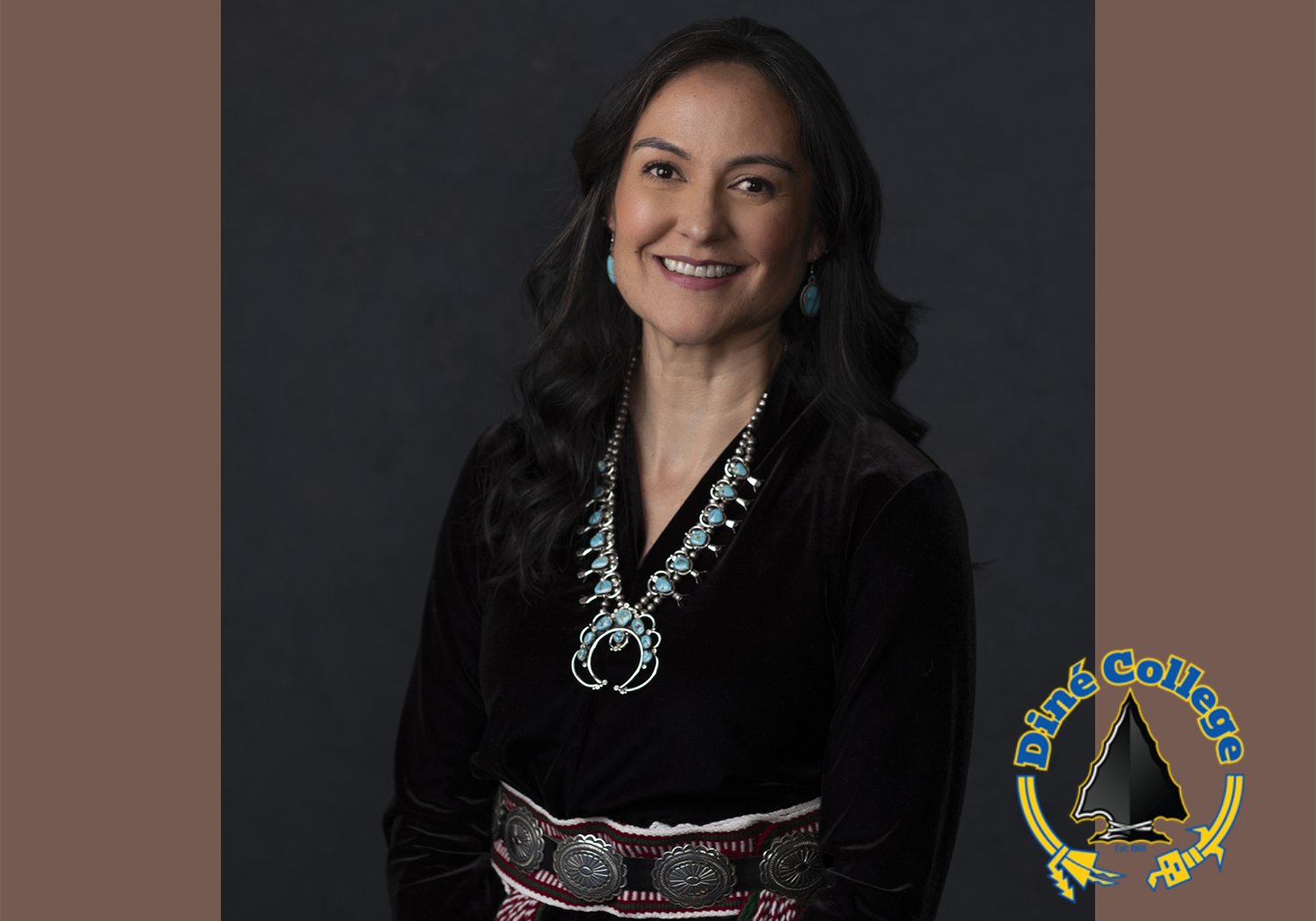
TSAILE, Ariz. Oct. 7, 2026. Diné College President Dr. Deborah Jackson-Dennison delivered her first State of the College address Wednesday, placing student success at the center of the College’s work as it responds to enrollment challenges, financial pressures, aging infrastructure and the changing needs of the Navajo Nation.
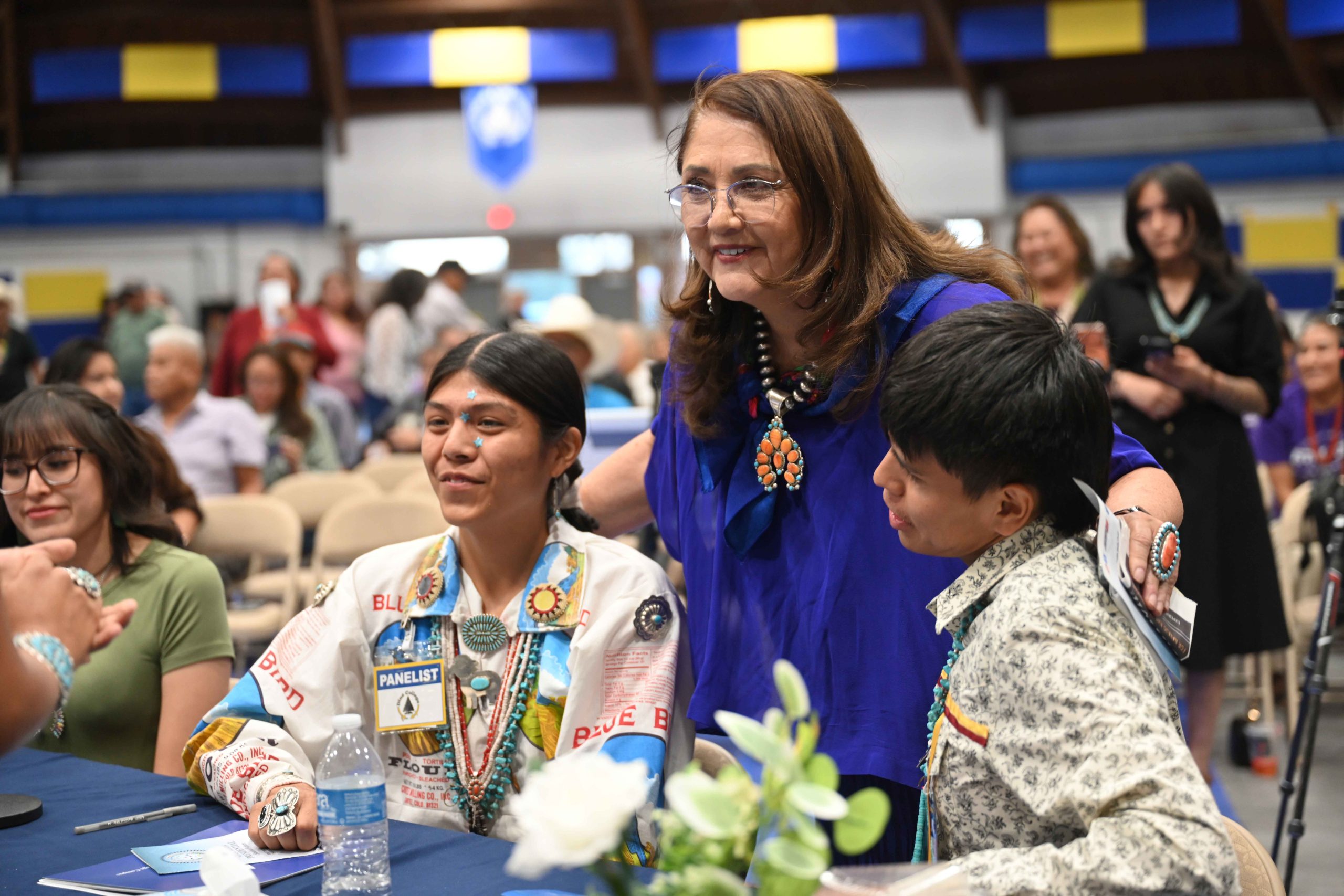
Speaking during Diné College’s Annual Meeting at the Piñon Pit Gymnasium in Tsaile, Jackson-Dennison reflected on the College’s history, assessed its current challenges and outlined priorities that will help shape a new 2027–2031 Strategic Action Plan.
“Students must remain at the center of every decision we make, every program we design, every partnership we develop and every policy we implement,” Jackson-Dennison said, reaffirming a commitment she made during her inauguration on April 16.
Jackson-Dennison, who became president in March 2026, said her first several months in office have focused on assessing institutional operations, strengthening accountability, clarifying responsibilities and addressing systems and practices that require improvement.
“Before we could build forward, we had to strengthen the systems underneath us,” she said.
Enrollment Requires a College-Wide Response
Jackson-Dennison identified enrollment as one of the most significant challenges facing Diné College.
Historical data presented during the address showed that enrollment reached nearly 6,000 students in 1994. Today, the College serves a significantly smaller student population. While online instruction contributed to an increase from 1,315 students to 1,837 students in fall 2023, enrollment has since declined.
Jackson-Dennison said the trend reflects broader demographic and economic changes affecting the Navajo Nation, including declining birth rates, limited employment opportunities in many communities and the movement of Navajo families to urban areas.
Those realities, she said, require Diné College to rethink where its students are, how it reaches them, and how effectively the College supports them from recruitment through graduation.
“Enrollment is not simply a Student Affairs issue. It is an institutional responsibility,” Jackson-Dennison said. “Our next chapter will not be determined by the enrollment trend. It will be determined by what we do about it now.”
She called for stronger recruitment and dual-credit efforts, streamlined registration and financial aid processes, improved retention strategies and renewed outreach to students who attended Diné College but left before completing their degrees.
Strengthening Financial, Operational and Institutional Systems
Jackson-Dennison also discussed financial, operational and infrastructure challenges identified during her first months as president.
The College has worked to address delayed funding, improve financial controls, and strengthen the tracking and management of institutional resources. The administration also responded to challenges involving federal student financial aid that affected students and enrollment and has worked to restore and strengthen those processes.
At the same time, the College is addressing deferred maintenance and infrastructure needs involving roads, sidewalks, housing and campus facilities. Administrative operations, organizational responsibilities, policies and procedures are also being reviewed to reduce duplication, improve accountability, and better align resources with institutional priorities.
Jackson-Dennison emphasized that strong internal systems are essential to the College’s ability to seek additional support from governments, donors, and other partners.
“We must demonstrate responsible stewardship of the resources entrusted to us,” she said. “That strengthens our ability to advocate for the additional investments our students and our College need.”
Building Toward 2031
Looking ahead, Jackson-Dennison outlined priorities that will help guide development of the College’s 2027–2031 Strategic Action Plan.
Among the priorities is rebuilding the Student Union Building, which was destroyed by fire in April 2025. Jackson-Dennison said the loss has highlighted the need for a central place where students can gather, study, connect, and participate in campus life.
The College is also working to revitalize the student experience through athletics and community and cultural activities, including the return of basketball, continued support for rodeo, the annual powwow, the Ned Hatathli Memorial Rodeo and other events that bring students, families and communities to Diné College.
Expanding access is another priority. Jackson-Dennison said Diné College must understand where Navajo students live today and develop educational pathways that reach them, including students in urban communities such as Phoenix, Albuquerque, Salt Lake City, Denver and Los Angeles.
The College is also advancing federal legislative efforts related to the Navajo Community College Act and advocating for a stronger federal funding framework that recognizes Diné College’s unique history, mission and responsibility to the Navajo Nation. College leaders traveled to Washington, D.C., in September to advance those discussions.
Jackson-Dennison also announced efforts to reestablish and strengthen the Diné Policy Institute as a research and policy center capable of providing data, analysis, and research to support the Navajo Nation and its communities. Diné College has begun discussions with institutions including Arizona State University and the University of New Mexico about potential research partnerships.
In Shiprock, New Mexico, the College is exploring opportunities for long-term growth, including expanded academic programming and future student and faculty housing.
These initiatives will be incorporated into the development of the 2027–2031 Strategic Action Plan, which Jackson-Dennison said will include measurable goals, assigned responsibilities, timelines, and annual reporting on progress.
The broader vision, she said, is for Diné College to be financially sustainable and responsible, academically excellent, culturally grounded, student-centered, and a leading Tribal College and University for research, education and nation-building.
“The work is not simply to preserve Diné College,” Jackson-Dennison said. “It is to strengthen what we have inherited, restore what our students and communities need, and prepare the College for what it must become next.”
Honoring the Leadership That Came Before
Jackson-Dennison opened her address by recognizing Diné College’s presidents and leaders from its founding in 1968 to the present, noting that each “inherited a responsibility, carried it for a time, and passed it forward.”
She recognized founding President Robert Roessel and Ned Hatathli, the College’s first Navajo president. She also honored her late father, former Diné College President Dean C. Jackson, and acknowledged former President Dr. Maggie George, who attended the meeting.
Jackson-Dennison shared words from her father that continue to guide her leadership: “Knowledge is many things gained through many experiences. But true knowledge is knowing your reason for being and becoming.”
She concluded her first State of the College address by asking the Diné College community to consider two questions as the institution begins planning for its next chapter: “What must we carry forward? And what must we now have the courage to change and build?”
About Diné College
Diné College is a tribal college in Tsaile, Arizona, proudly serving the Navajo Nation. Led by President Dr. Deborah Jackson-Dennison and governed by its Board of Regents, the College integrates Diné language, culture, and values into higher education, empowering students to strengthen their families, communities, and the Nation’s shared future. For more information visit our website at: www.dinecollege.edu