Diné College President Outlines Vision for Student Success, Strategic Growth and Nation-Building at 2026 Fall Convocation
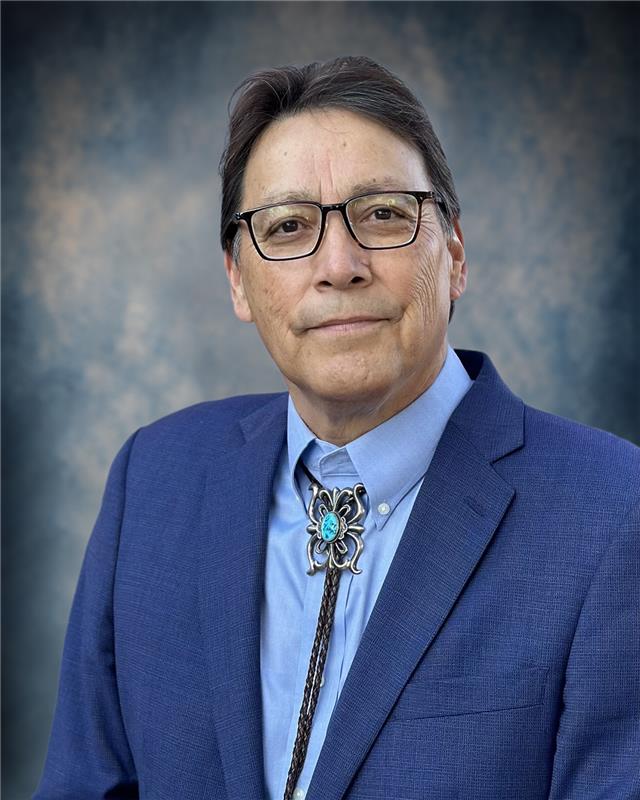
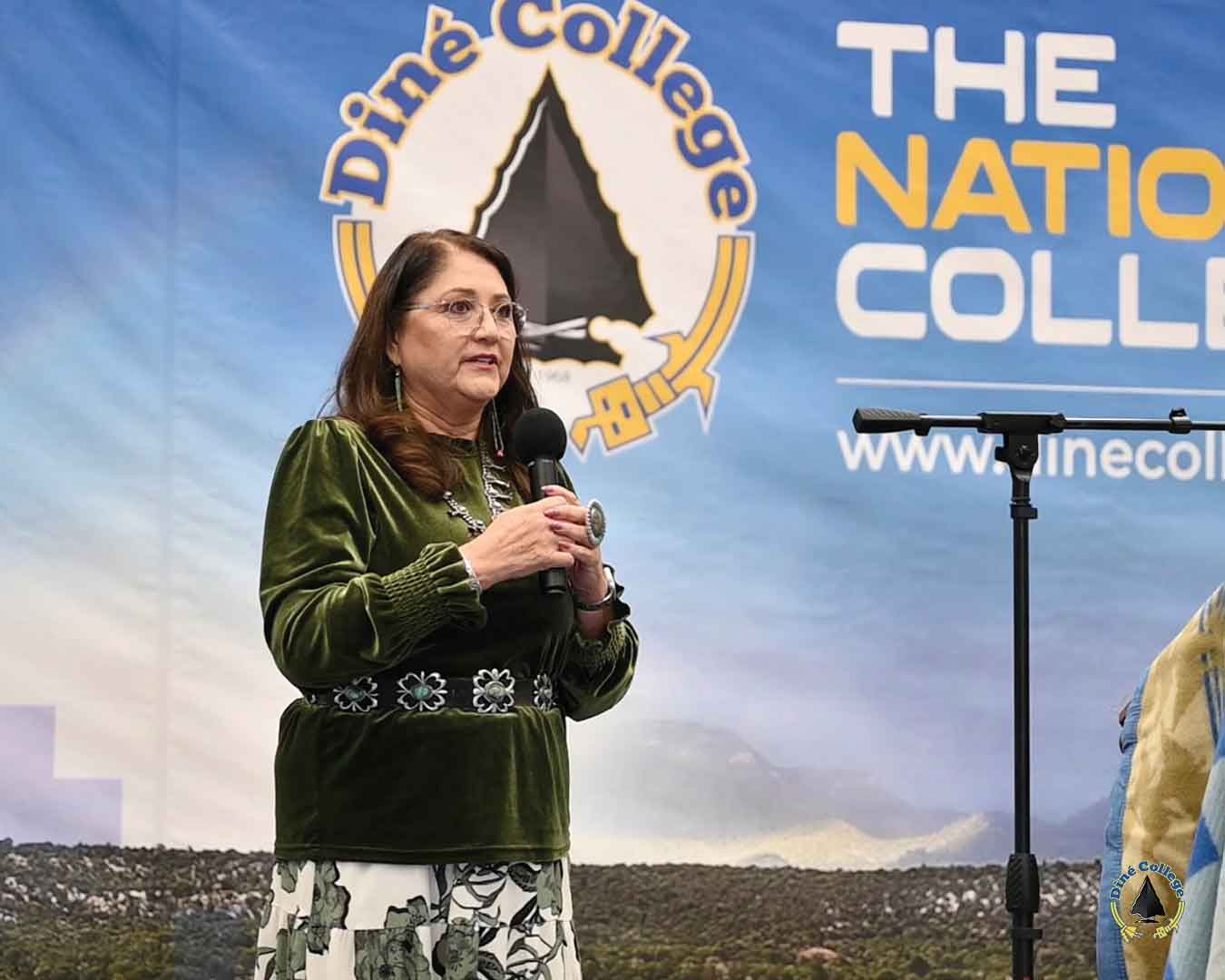
TSAILE, Ariz., Aug. 10, 2026. Diné College President Dr. Deborah Jackson-Dennison welcomed faculty and staff to the College’s 2026 Fall Convocation at the Piñon Pit Gymnasium, marking the beginning of the 2026–2027 academic year and her first fall convocation as the 19th President of Diné College.
Under the theme “Honoring Our Past. Strengthening Our Present. Creating Our Future,” Jackson-Dennison reflected on the historic mission of Diné College, introduced members of the College’s executive leadership team, and outlined a forward-looking vision centered on student success, academic excellence, institutional accountability, strategic partnerships, workforce development and nation-building.
Jackson-Dennison emphasized that Diné College was established with a purpose that extends beyond providing access to higher education. Founded in 1968 as Navajo Community College, the institution was created through the vision, prayers and determination of Diné leaders who believed higher education should affirm the identity, language, culture, values and aspirations of the Navajo people while preparing future generations to strengthen the Navajo Nation.
“This is what our forefathers and our ancestors prayed for,” Jackson-Dennison said. “They struggled for this. They wanted a way to educate our people that would affirm who we are and strengthen our identity, while providing the knowledge and skills needed to strengthen our communities and build our Nation.”
She challenged employees to carry that founding purpose forward while preparing Diné College to meet the changing educational, economic, and workforce needs of the Navajo Nation.
Strengthening Executive Leadership and Institutional Accountability
Jackson-Dennison introduced members of the College’s executive leadership team and emphasized their collective responsibility for advancing institutional priorities, strengthening accountability and improving services to students.
The leadership team includes Serena Denetsosie, Vice President of Institutional Advancement; Sharonna Yazzie-John, Vice President of Finance and Administration; Patrick Blackwater, Provost; Glennita Haskey, Vice President of Student Affairs; Leon Jackson, Chief Operating Officer; and Jennifer VanHorssen, Human Resources Director.
Jackson-Dennison said the executive leadership team meets weekly to address institutional priorities, identify solutions, strengthen accountability and improve coordination across the College.
She also called upon faculty and staff to strengthen a culture of communication, collaboration, trust and mutual accountability.
“My door is open,” Jackson-Dennison said. “We need to communicate with one another, address concerns directly and work together to find solutions. That is how we build trust, strengthen our institution and model respect for our students.”
Her message emphasized a “One College, One Team” approach in which academics, student services, operations and administration work collectively toward student success rather than functioning independently.
Expanding Access to Diné Higher Education
A major component of Jackson-Dennison’s vision is expanding the reach of Diné College to better serve Navajo students wherever they live.
While Diné College will continue strengthening its existing campuses and centers across the Navajo Nation, Jackson-Dennison said the College must also respond to demographic and enrollment trends showing significant populations of Navajo people now living in metropolitan areas beyond the Navajo Nation.
The College is exploring opportunities to establish a stronger educational presence in major urban centers, including Phoenix, Albuquerque, Salt Lake City, Los Angeles and Denver, as well as other communities with significant Navajo populations. These areas are home to growing numbers of Navajo families, working adults, college-age students and future college students who may benefit from greater access to Diné College.
Potential strategies include partnerships with other educational institutions and community organizations, instructional sites, hybrid and online programs, cohort-based programs and other innovative approaches that extend access to a Diné College education while preserving the cultural foundation that distinguishes the institution.
Jackson-Dennison emphasized that expanding into urban communities is about more than increasing enrollment. It is an opportunity to reconnect Diné students living away from the Navajo Nation with their language, culture, identity and community while providing pathways to degrees, credentials, careers and leadership opportunities.
“Wherever our students are, we should be asking how Diné College can reach them,” she said. “Our responsibility is to create pathways that allow our people to pursue higher education while remaining connected to who they are.”
Building Strategic Partnerships
Jackson-Dennison also identified strategic partnerships as essential to the College’s future.
Diné College is strengthening relationships with institutions such as Arizona State University (ASU) to explore educational pathways, leadership development, research, economic development and other opportunities that expand educational and professional opportunities for Diné College students while supporting the long-term needs of the Navajo Nation.
At the same time, the College is strengthening the role of the Diné Policy Institute (DPI) as a center for research, policy analysis and informed dialogue on issues affecting the Navajo Nation.
Through DPI and partnerships with universities, Tribal entities, government agencies, school systems, industry and community organizations, Diné College intends to expand its capacity to address critical issues facing the Navajo Nation, including economic development, education, workforce preparation, public policy and community well-being.
Jackson-Dennison said the goal is for Diné College to increasingly serve as a trusted source of research, knowledge, leadership and policy expertise for the Navajo Nation while creating meaningful opportunities for students to participate in research, policy development and nation-building.
Growing Programs for the Navajo Nation’s Future
Jackson-Dennison called for continued development of academic and leadership programs aligned with the workforce, professional, cultural and community needs of the Navajo Nation and surrounding region.
Priority areas include teacher education and educational leadership, healthcare, science, technology, engineering, agriculture, business and other high-demand fields. The College is also exploring culturally grounded initiatives such as the Hataałii mentorship and Naat’áanii the Student Leadership Center, recognizing that the future of the Navajo Nation requires both professional expertise and the preservation and transmission of Diné knowledge, language, leadership and ways of life.
Jackson-Dennison emphasized the importance of creating educational pathways that prepare Navajo students not simply to enter the workforce, but to become the Nation’s future teachers, principals, superintendents, healthcare professionals, scientists, engineers, entrepreneurs, policymakers, traditional practitioners and leaders.
The College’s future academic growth, she said, must be informed by workforce data, community needs and opportunities to strengthen the Navajo Nation’s economic self-sufficiency, sovereignty and capacity to develop its own future leaders.
“We must grow our own,” Jackson-Dennison said. “We must prepare the people who will teach our children, lead our schools, care for our people, strengthen our communities, build our economy and help shape the future of the Navajo Nation.”
Honoring the Past While Creating the Future
Established in 1968, Diné College was the first tribally controlled college in the United States. Its creation became a catalyst for the Tribal College and University movement, demonstrating that Tribal Nations could establish and govern institutions of higher education grounded in their own cultures, languages, knowledge systems and priorities.
Today, that legacy continues to shape Diné College’s responsibility to future generations.
Jackson-Dennison reminded employees that institutional transformation ultimately begins with the experience and success of each student. Every classroom, interaction, policy, program and decision, she said, should be evaluated by how it contributes to student learning, belonging, persistence and success.
She closed her address by calling upon the College community to honor the courage, sacrifice, prayers and vision of those who established Diné College while embracing its responsibility to prepare the institution for generations yet to come.
“Our founders dreamed and prayed boldly about what education should become for the Navajo people,” Jackson-Dennison said. “Now it is our responsibility to dream and pray just as boldly about what Diné College can become, honoring our past, strengthening our present and creating our future, together as One Team, One College, the Nation’s College.”
About Diné College
Diné College is the first tribally controlled and accredited collegiate institution in the United States. Founded to serve the Navajo Nation, the college integrates Diné values, language, and culture with rigorous academic study, preparing students to thrive in their communities and beyond. Through a commitment to student success, cultural identity, and lifelong learning, Diné College advances educational opportunity grounded in the principles of Sa’ąh Naagháí Bik’eh Hózhóón.