Diné College Workshop Equipped Farmers and Ranchers to Face Drought
TSAILE, Ariz. Diné College hosted a free workshop on USDA drought programs Thursday, Oct. 22, at the Diné College Gym. Farmers and ranchers learned about federal programs, land care methods and recordkeeping tools to help them prepare for and respond to drought. The event ran from 9 a.m. to 3 p.m.
Dr. Miranda J. Haskie, professor in the School of Business and Social Science at Diné College, organized and hosted the event. Speakers covered water harvesting, cover crops, recordkeeping and watershed planning. They also explained USDA insurance programs that protect farm and ranch income.
Heavy rain fell the day of the event. Organizers had planned field visits to local homesites but canceled them after muddy roads stranded a truck delivering water tanks.
Russell Tronstad of the University of Arizona noted the timing. “We figured out how to really mitigate the impacts of drought by scheduling the workshop on it,” he said.
Tronstad said the workshop grew from a grant project aimed at getting more local producers to use available programs.
“The idea of this program is to increase the participation in programs that are kind of underutilized,” Tronstad said.
He explained Livestock Risk Protection, a program that guards ranchers against falling cattle prices. “It essentially puts in a price floor, so it protects against price decline,” he said. According to Tronstad, the program now covers up to about 65% of the premium for qualifying producers.
Tronstad also described Micro Farm insurance, which protects a farm’s total income when drought or low prices cut earnings. He said the program subsidizes 80% of the premium — the highest rate of any federal crop insurance product. Beginning farmers can receive up to 90%.
“We’re definitely underutilizing, I think, the dollars that could be coming back here to the community as individual growers,” Tronstad said.
Tronstad stressed the value of good records. “A lot of the government programs now require some records,” he said.
Each attendee received a recordkeeping workbook with a water-resistant pocket notebook for use in the field. Ranchers and farmers can use them to track livestock, crops, feed costs and water hauling expenses.
Melinda O’Daniel, executive director of Seeds of Harmony LLC, led the session on rainwater harvesting. She is a certified rainwater harvesting practitioner.
O’Daniel said less than half of 1% of all the water on Earth is fresh and ready for use. Rain and snow are the only ways to refill it.
“Rainwater harvesting brings hope for local homesteads,” O’Daniel said.
She shared eight principles of rainwater harvesting and urged producers to slow water down, spread it out and let it soak into the soil. She noted that many of these methods draw from traditional ecological knowledge.
O’Daniel called rainwater harvesting “accessible, cost effective and passive.”
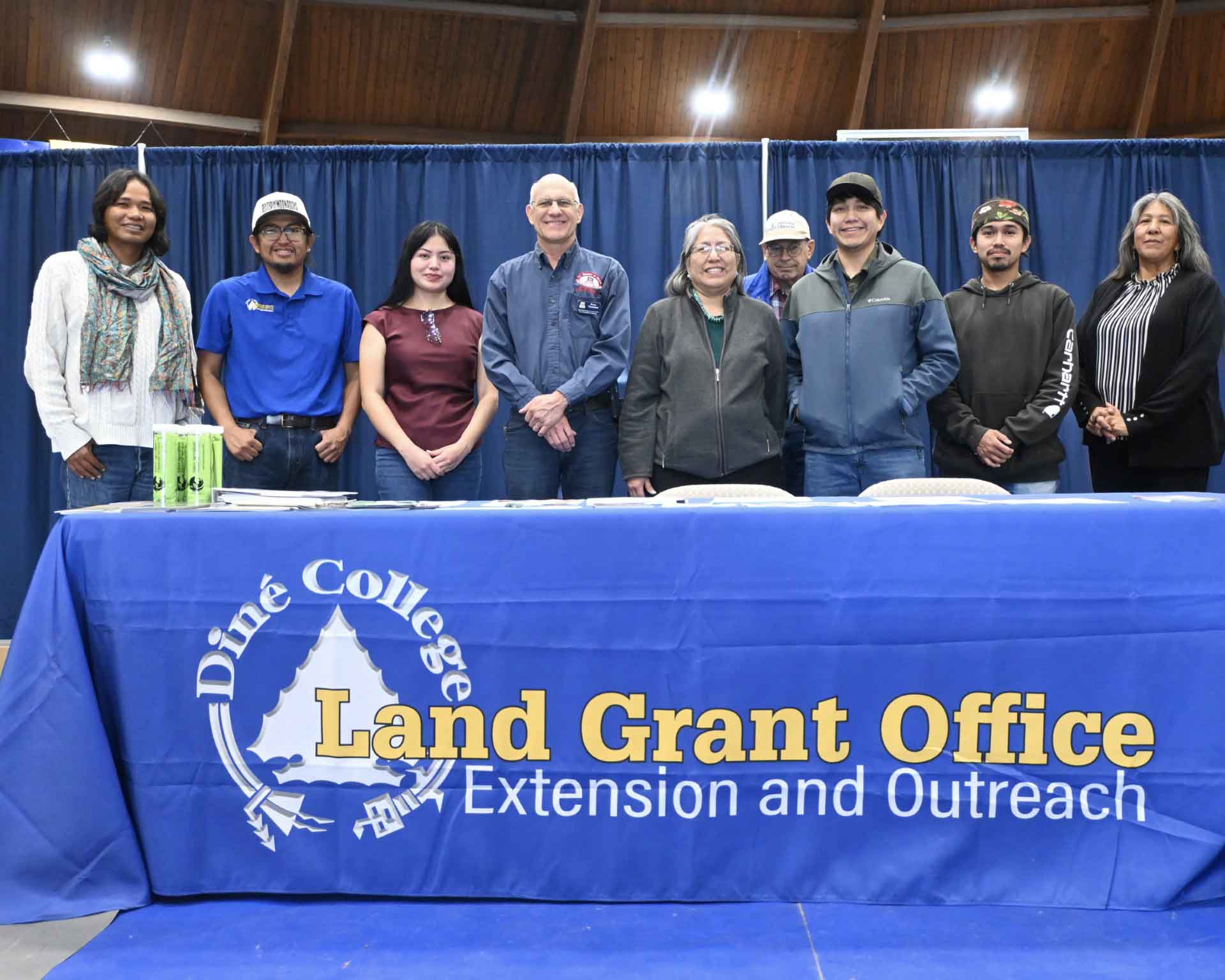
Tyler Begay of the Diné College Land Grant Office Extension and Outreach spoke on cover crops — plants grown to protect and feed the soil between harvests.
Begay explained how grasses, legumes, mustards and root vegetables each support the land. Some add nutrients. Others block weeds, stop erosion or loosen compacted soil.
“As long as you have something growing, there’s not enough room for the weeds to come back out and compete,” Begay said.
He advised growers to buy seeds from local vendors. “That way, the plants that you’re buying are acclimated to the area,” he said.
The workshop was organized and hosted by Dr. Miranda J. Haskie and sponsored by Diné College Land Grant Office Extension and Outreach, the University of Arizona Cooperative Extension, Western Extension Risk Management Education, the U.S. Department of Agriculture and the National Institute of Food and Agriculture.
For more information, contact Dr. Haskie at (928) 724-6715 or mhaskie@dinecollege.edu.