Diné College Student Sets Record, Defends Biology Thesis on Brain Signal Research
TSAILE, Ariz. Sheldon N. Chee successfully defended his master’s thesis in biology on May 4, 2026, becoming the sixth graduate in the program and the second Honors Scholar to earn both his graduate and undergraduate degrees at the same time. He finished both degrees in just two years and wrote three first-author research papers along the way.
Chee’s thesis was titled “Linear and nonlinear signal synchrony measures to assess salt bridge shorting and conventional disc electrode emulation via tripolar concentric ring electrode on human electroencephalogram data.” The full video of his public thesis defense is available on the College’s YouTube channel at https://www.youtube.com/watch?v=RhaNh-uA8eg.
“While every Honors Scholar journey is remarkable, Sheldon has set a new record by completing both degrees in just two years and writing three first-author papers in the process,” said Dr. Oleksandr Makeyev, Chee’s thesis advisor.
The most important part of Chee’s research showed that no salt bridge shorting occurred between the recording surfaces of a concentric ring electrode on resting human brain signal data. Salt bridge shorting has long been seen as a risk for this kind of electrode. The recording surfaces sit close together, and the electrode only works well if each surface picks its own unique signal. If shorting happened, the signals would look the same. Chee proved that the signals stayed unique. He did this by using linear and nonlinear signal synchrony measures, which he calculated between pairs of individual signals.
“Assessment of salt bridge shorting has been discussed as an important future work direction for concentric ring electrodes for over a decade now, until Sheldon tackled it,” Dr. Makeyev said. “The other, emulation-based portion of his thesis had to wait even longer to be addressed.”
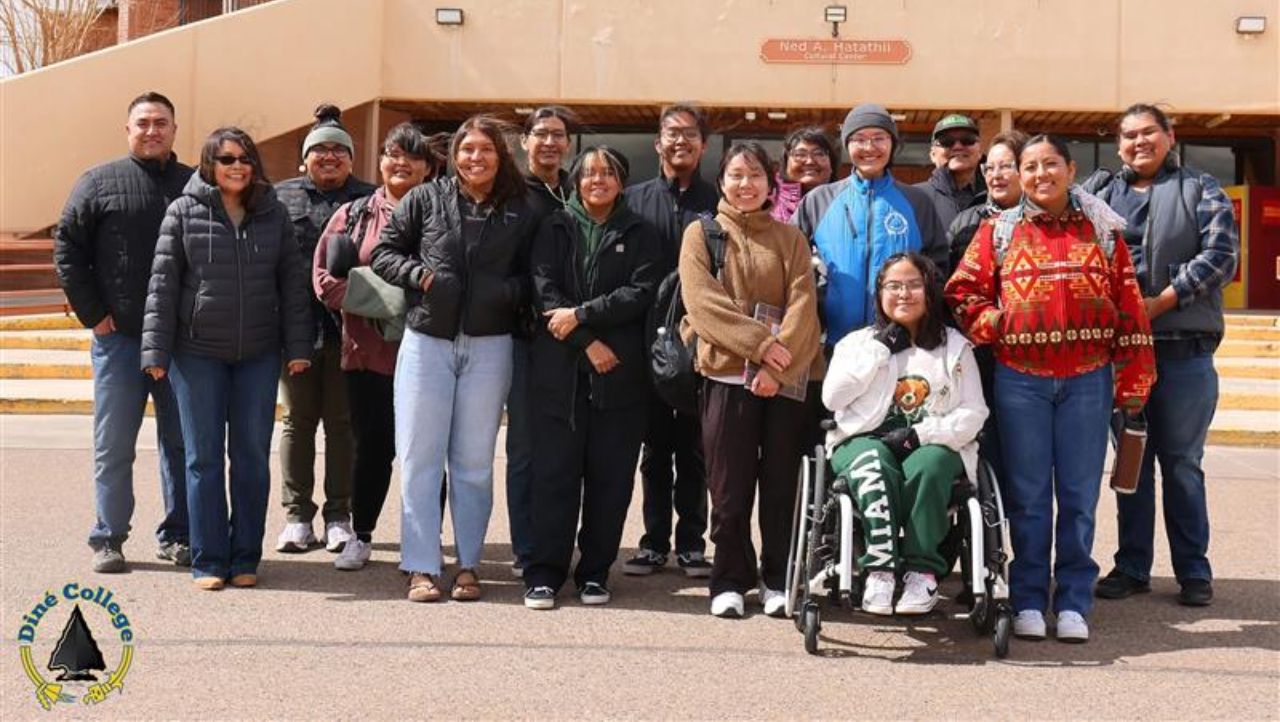
Chee presented his salt bridge shorting results in person at the 2026 NSF TCUP Research Symposium. The event took place in Alexandria, Va., on May 19-21. He attended with two other students from Dr. Makeyev’s Mathematics for Engineering Applications (MEA) lab: Dominique D. Clichee and Meagan H. Damon.
Clichee and Damon had been with the MEA lab for just one semester as part of their BIO485 Undergraduate Research course. Clichee presented a poster titled “Analysis of variance to assess statistical significance of effects of gelatin and salt concentrations on resistance of phantom model.” Damon presented a poster titled “Expanding comprehensive optimization problem solutions for a wider range of concentric ring electrodes.”
“BIO485 students have all done a phenomenal job at the MEA lab, with several peer-reviewed papers currently being prepared for submission based on their research,” Dr. Makeyev said.
Looking ahead, Chee plans to earn his PhD while also holding a faculty position at a Tribal College or University. He hopes to pursue both goals at once — a path his time as an Honors Scholar has prepared him well to follow.
About Diné College
Diné College is the first tribally controlled and accredited collegiate institution in the United States. Founded to serve the Navajo Nation, the college integrates Diné values, language, and culture with rigorous academic study, preparing students to thrive in their communities and beyond. Through a commitment to student success, cultural identity, and lifelong learning, Diné College advances educational opportunity grounded in the principles of Sa’ąh Naagháí Bik’eh Hózhóón.
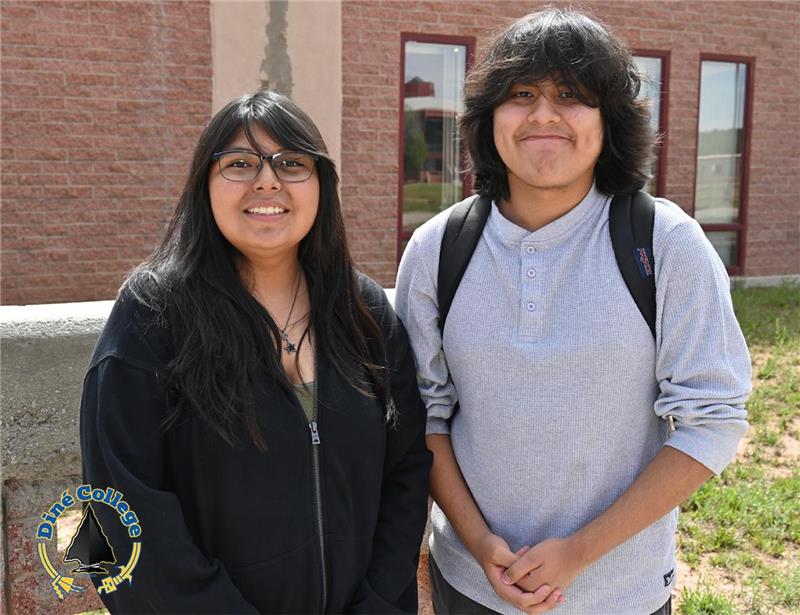
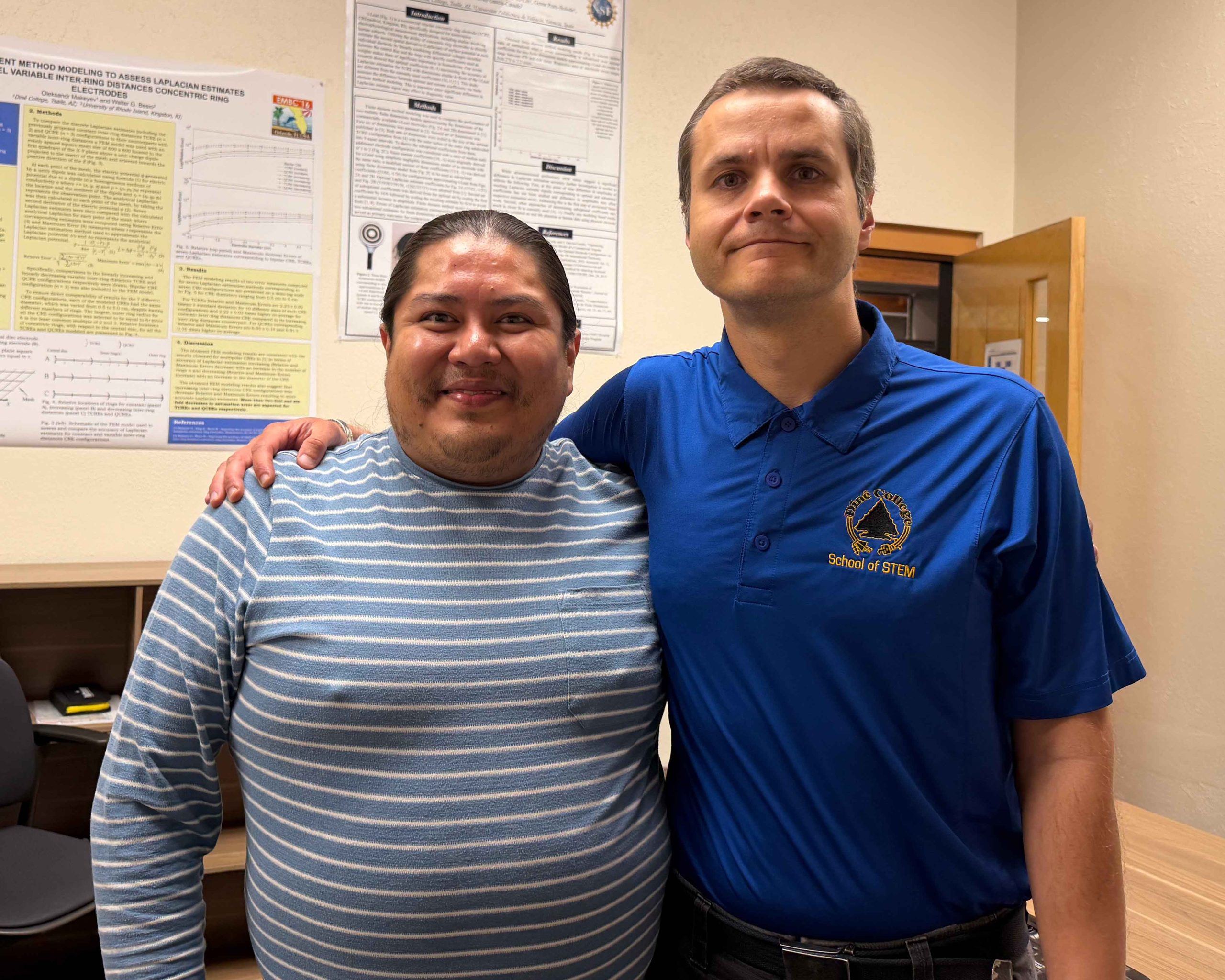
(PHOTO: L-R: Sheldon Chee & Dr. Oleksandr Makeyev)
Media Contact:
Email: marketing@dinecollege.edu