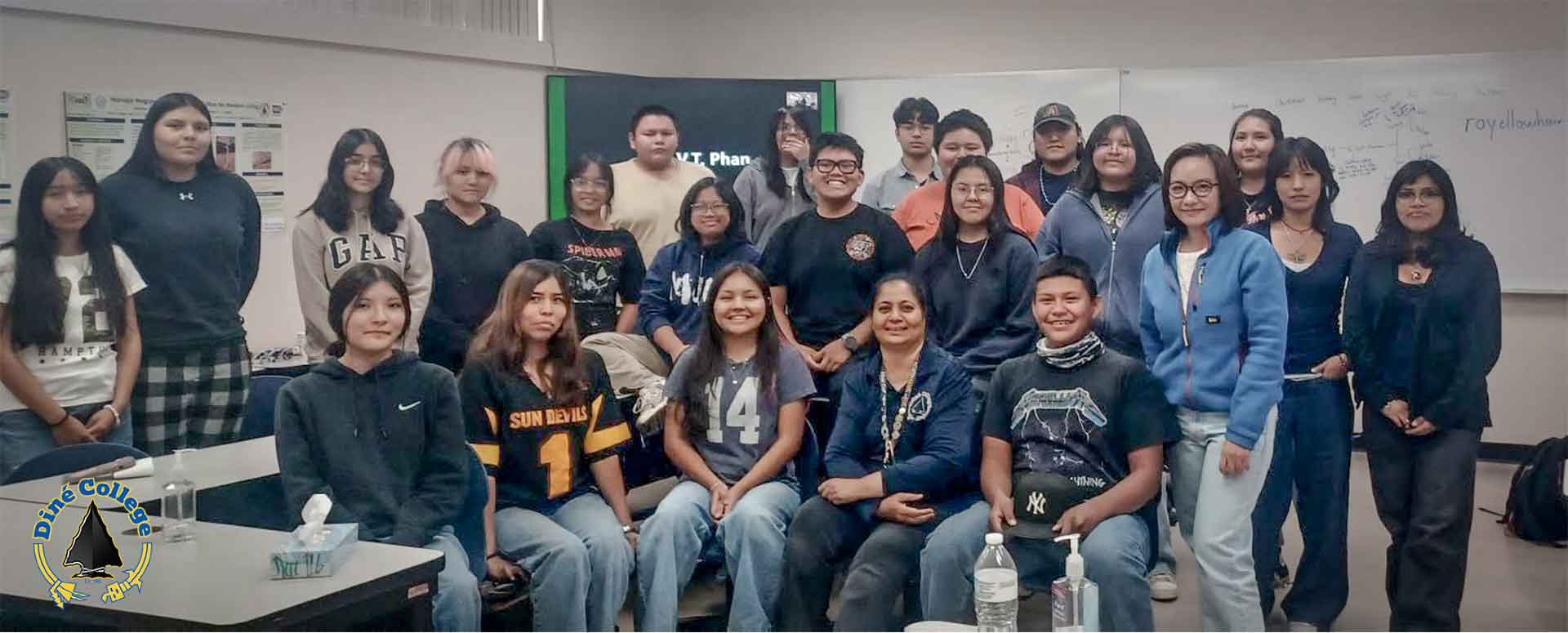
Tuba City Students Join Diné College’s CONVOY Program, Blending Navajo Tradition with Science
Tuba City, Ariz. Twenty-five students from Tuba City Junior High School have earned spots in Diné College’s 2026 NIH-CONVOY Summer Program, where the enduring wisdom of Diné teaching meets the tools of modern biomedical science. Grounded in the pillars of Navajo Education Philosophy — Nitsáhákees (thinking), Nahat’á (planning), Iiná (living) and Sih Hasin (Reflecting) — these young scholars will study laboratory techniques, work alongside other participants, and dedicated mentors, to explore how Western research and Diné traditional knowledge can strengthen one another, preparing them to serve their families and communities with both knowledge and purpose.
“We are thrilled to announce that the students accepted into the 2026 NIH-CONVOY Summer Program,” the school’s post read. “This is an incredible opportunity for participants to develop skills in biomedical techniques while working directly with inspiring mentors and experts in science. Please join us in celebrating our five selected students.”
CONVOY operates through Diné College’s School of STEM. The five-year NIH Science Education Partnership Award (NIH-SEPA) funds the program from 2023 through 2028. It encourages middle school, high school, and college youth to explore careers in biomedical science, healthcare, and research, while weaving Diné traditional knowledge together with Western science. The program also builds a near-peer mentorship system, in which Diné College students and their professors guide younger students.
Participants tackle a wide range of activities. They extract DNA and run PCR and gel electrophoresis, study bioinformatics, and explore neuroscience using fruit flies. They dig into microbiology and forensic science and earn CPR and First Aid certification. On the engineering side, students build prototype rotors and centrifuge machines, launch high-altitude balloon experiments, build robotics, cook with solar ovens, and use spectrophotometry. Through the NIS-111 course, they study Navajo culture, including blessing and protection ceremonies, weaving, and the collection of traditional medicinal herbs. Field trips take them to Monument Valley, the Grand Canyon, Hart Perrier, and Cow Spring.
The program lasts 20 weeks across the summer and fall. Every year, 24 Students earn three dual college credits through NIS-111, Foundation of Navajo Culture. Each also receives a $3,300 stipend, up to $1,000 for an individual research project, and $1,000 for conference travel. Students present their research work at the American Indian Science and Engineering Society (AISES) conference. In 2024, 22 interns presented 12 projects in San Antonio, Texas. In 2025, 20 interns shared research in Minneapolis, Minnesota. This year, 25 students will be presenting in Portland, Oregon.
CONVOY engage collaborators from Arizona State University, the University of Arizona, the University of New Mexico, the University of Utah, Sandia National Laboratories, Tuba City Regional Healthcare Corporation, Hopi-IHS, and the Land Grant Office at Diné College to offer training during 10 weeks of summer.
One 2025 participant reflected in an end-of-summer survey: “Convoy has greatly impacted my life and my future career choice. Before Convoy, as a Native American student, I had been struggling with the idea of going into a health field where I would be going against some of my cultural traditions. However, the program helped me to look at the science field in a different way. I have built a deeper connection to my culture and science.”
“I am pleased to see that our vision of building a bridge between traditional knowledge and Western medicine, while fostering a deeper understanding of biomedical career pathways, is being realized through the CONVOY program,” said Professor Dr. Shazia Tabassum Hakim, Interim Dean of the School of STEM and CONVOY Program Director and Principal Investigator. “We hope to continue this program for many years, empowering our youth to make informed decisions about their future, their families, and their communities with confidence.”
Dr. Hakim credited her Co-Principal Investigators, Dr. Babatunde Ojo, Ms. Francetta Begay, Ms. Marquel Begay, Mr. Lorenzo Max, and Ms. Phyllis Begay, along with Research Administrative Assistant Ms. Maya Begay, for the program’s success.
Diné College is the first tribally controlled and accredited collegiate institution in the United States. Founded to serve the Navajo Nation, the college integrates Diné values, language, and culture with rigorous academic study, preparing students to thrive in their communities and beyond. Through a commitment to student success, cultural identity, and lifelong learning, Diné College advances educational opportunity grounded in the principles of Sa’ąh Naagháí Bik’eh Hózhóón.
For more information, visit https://www.dinecollege.edu/convoy/.