Diné College Students Study Navajo Textiles Through Museum Internship
TSAILE, Ariz. August 26, 2026. Diné College students gained hands-on experience this fall by assisting with curating an exhibit of historic Navajo textiles at the Diné College Museum. The exhibit, titled “Returning Home: Navajo Textiles, Memory and the Living Archive,” featured weavings dating from the 1800s to the early 1900s.
The Heard Museum in Phoenix donated the textiles, which had once been sold or traded off the reservation and had traveled before returning to the Navajo homeland. Students studied the pieces as part of the Museum Internship course taught by Dr. Nonabah Sam, learning how to care for their ancestors’ work while engaging with the fields of textile research and museum studies.
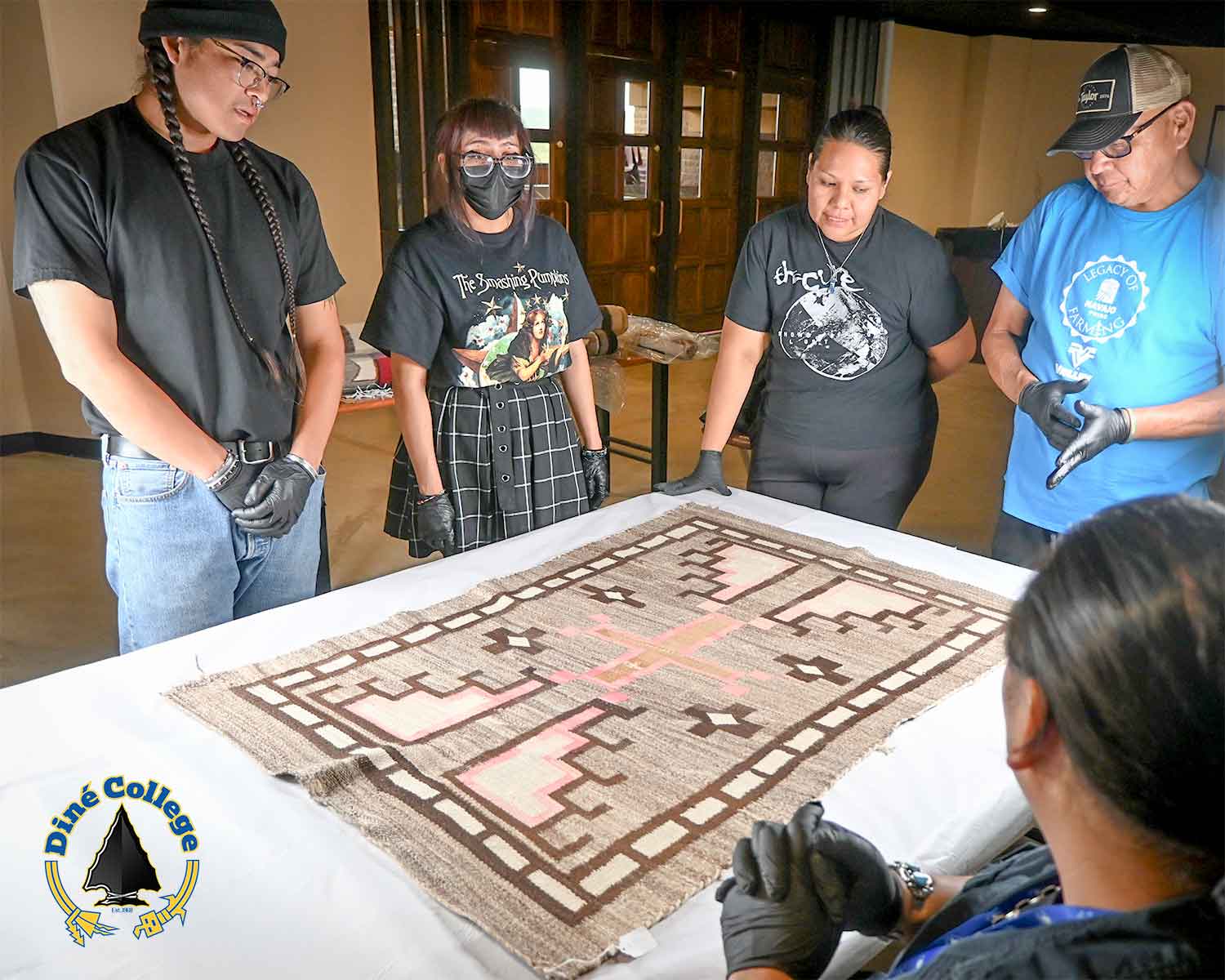
Students examined each textile closely. They checked the materials, weaving techniques, and condition of every piece. They looked for moth damage, stains, and other signs of age. Each detail told part of the textile’s story. Venancio Aragón, the college’s Navajo Weaving and Textile Design instructor, assisted with the curation. He said the project gave students a rare chance to study the work of their own people. “The students have this rare opportunity to study the material culture of our own ancestors,” Aragón said. “These objects have traveled. They were sold off the reservation and collected. And then they returned home.”
Aragón said many students conducted research with historic objects for the first time. “From every single one of them, I see their faces light up,” Aragón said. “I reinforced to them that some of the people who made these weavings might have been their direct ancestors.” The course also asked students to think about the role of a museum in an Indigenous space. Students learned about older, colonial models of curation. They also explored ways to bring Navajo cultural beliefs into the museum to Indigenize and decolonize their work. “They’re learning how to approach curation from a culturally grounded perspective,” Aragón said. He explained that some textiles may not be acceptable for community display based on cultural teachings, and students learned to respect those limits.
Shimayne Charley, a senior from Chinle and a Bachelor Fine Arts major, called the class a highlight of her final year. “We’re taught that these are actually our grandpas and grandmas, and these are our ancestors,” Charley said. “We are taught to handle them with care and love, and we have to respect everything that’s given to us.” Charley said she learned to use proper tools, gloves, and masks. Some rugs carried old pesticides, so careful handling mattered. She also learned about weaving patterns and the ways each artist expressed ideas through geometry and design.
“We are thankful to the Heard Museum for donating these textiles to us,” Charley said. “This is the first time that student curatorial services get to be hands-on. I am very grateful.” Charley hopes future students and the public will see the exhibit. She also shared a message for visitors. “Come here with an open mind,” Charley said. “Think: This is your grandma’s; this is your grandpa’s. These are your ancestors. This is a family. Respect what you see, and learn about where you came from.”
About Diné College
Diné College is a tribally controlled college that serves the Navajo Nation. The college offers programs grounded in Navajo culture, language, and values. Its Museum Internship course teaches students the skills needed for museum careers, including collection of care, condition assessment, and exhibit curation.
About the Heard Museum Donation
The Heard Museum in Phoenix donated the Navajo textiles to Diné College after removing them from its own collection. The gift allowed the weavings to return to Navajo land. Students now study and care for the pieces as part of the college’s living archive.